
Free Online Law Search Engine.
http://mindworks.altervista.org/index.html
This is my new web site, with links to free online law search engines I authored as well as free copies of my law review articles. Enjoy saving your law firm some westlaw and lexis fees.
Here is my amazon author page: http://amazon.com/author/quizmaster
If you read one of my books feel free to contact me: engleerica@yahoo.com
I write for you and want you to be happy.
February is only a four months away!
This is my new web site, with links to free online law search engines I authored as well as free copies of my law review articles. Enjoy saving your law firm some westlaw and lexis fees.
Here is my amazon author page: http://amazon.com/author/quizmaster
If you read one of my books feel free to contact me: engleerica@yahoo.com
I write for you and want you to be happy.
February is only a four months away!
Essay Questions on the Bar Exam
On the bar exam you will be given essay questions, much like the essays you have been writing for your law school exams. The test is seeking to see if you can spot legal issues and then structure coherent compelling arguments to answer those issues. To do so you will need to have learned hundreds (not thousands!) of rules.
One problem bar examinees have is panic. Lack of proper training, believing the bar to be "impossible" are two usual causes of panic. Panic causes examinees to either stare blankly, scared to write, or write rapid unstructured and ill considered ideas.
Panic is prevented by learning the law thoroughly and practicing for the exam.
You learn the law thoroughly best by understanding the reasons the legal rule is what it is. For example, we should know that the good faith purchaser of property for value without notice of defective title has good title against all the world except true owner, which seems logical. Since the good faith purchaser did not know the goods were stolen he is not a criminal. And to protect and preserve property it makes sense that the good faith owner of stolen goods ought to be presumed to have a relative mastery over those goods against all save their true owner, for the true owner may be dead or absent or even unaware that the goods were stolen.
We should also know that the good faith purchaser of a negotiable instrument without notice of a flawed title has good title against all the world, even against true owner, and this is a property right which vests on transfer - a right in rem. This is not a contractual right in personam which might be defeasible. That is, only "real" and not "personal" defences may be interposed against the good faith purchaser of negotiable instruments such as a promissory note or check.
Obviously, this requires us to know a lot of technical legal vocabulary. It is a lack of knowledge of this vocabulary which stops students from learning the rules. Focus on learning the rule "by heart" rather than understanding the reason for the rule which keeps the student from seeing all the nuances just summed up in the preceding paragraph.
You must know what "real" "personal" and "negotiable" and "in rem" and "in personam" mean
seems strange to new law students. If you do not then look them up. Whenever you meet a new term in law you must look it up otherwise you will not be able to learn the rule. Law is pains-taking but easy, it is not rocket science but does demand persistent study.
So: WHY does the law permit the good faith purchaser of commercial paper to take title good against all the world, even true owner? This counterintuitive rule exists to foster commercial transactions. Imagine what the business world would look like if this were not the rule. Claims would be made against buyers of propert for contractual breaches of which they were not party and know nothing about. Litigation would increase, and commercial trading would decrease to the impoverishment of all.
Without knowing the vocabulary you could not see all the issues lurking in a question which looks easy. Without understanding the reason for the rule you are less likely to even remember the rule, let alone to apply it properly.
Essay questions are all about
1) Spotting the Issue
2) Weaving Facts
3) Into Law
4) To reach a conclusion.
Keys to avoiding panic
1) If you don't know the rule -- make one up. You can score some points with an incorrect rule, but no points with no rule at all. Furthermore, the rule you make up is likely the correct rule, you just don't remember it with perfect certainty.
2) Argue in the alternative: "but if I am wrong", "but if the court disagrees with me". This tactic must be used sparingly and really only as a "backstop". Otherwise you would never run out of issues to argue and it would make your essay look like it was written by someone who does not know the law.
3) Know the vocabulary. Knowing vocabulary increases your confidence, makes it easier to discuss the law, and shows the examiners you likely know the law.
4) Know the reasons for the rules, not just what the rule is, because in a hard case we are not only arguing about whether these facts applied to that rule reach this outcome; we are also arguing about what the rule should be, that is we are arguing about whether to apply one of several competing rules. Fortunately for examinees, the bar currently does not focus on the abstruse arcane questions of which rule to apply, limiting its examination to the concrete questions of certain facts applied to settled laws.
In other words: yes YOU Can pass the bar!
One problem bar examinees have is panic. Lack of proper training, believing the bar to be "impossible" are two usual causes of panic. Panic causes examinees to either stare blankly, scared to write, or write rapid unstructured and ill considered ideas.
Panic is prevented by learning the law thoroughly and practicing for the exam.
You learn the law thoroughly best by understanding the reasons the legal rule is what it is. For example, we should know that the good faith purchaser of property for value without notice of defective title has good title against all the world except true owner, which seems logical. Since the good faith purchaser did not know the goods were stolen he is not a criminal. And to protect and preserve property it makes sense that the good faith owner of stolen goods ought to be presumed to have a relative mastery over those goods against all save their true owner, for the true owner may be dead or absent or even unaware that the goods were stolen.
We should also know that the good faith purchaser of a negotiable instrument without notice of a flawed title has good title against all the world, even against true owner, and this is a property right which vests on transfer - a right in rem. This is not a contractual right in personam which might be defeasible. That is, only "real" and not "personal" defences may be interposed against the good faith purchaser of negotiable instruments such as a promissory note or check.
Obviously, this requires us to know a lot of technical legal vocabulary. It is a lack of knowledge of this vocabulary which stops students from learning the rules. Focus on learning the rule "by heart" rather than understanding the reason for the rule which keeps the student from seeing all the nuances just summed up in the preceding paragraph.
You must know what "real" "personal" and "negotiable" and "in rem" and "in personam" mean
seems strange to new law students. If you do not then look them up. Whenever you meet a new term in law you must look it up otherwise you will not be able to learn the rule. Law is pains-taking but easy, it is not rocket science but does demand persistent study.
So: WHY does the law permit the good faith purchaser of commercial paper to take title good against all the world, even true owner? This counterintuitive rule exists to foster commercial transactions. Imagine what the business world would look like if this were not the rule. Claims would be made against buyers of propert for contractual breaches of which they were not party and know nothing about. Litigation would increase, and commercial trading would decrease to the impoverishment of all.
Without knowing the vocabulary you could not see all the issues lurking in a question which looks easy. Without understanding the reason for the rule you are less likely to even remember the rule, let alone to apply it properly.
Essay questions are all about
1) Spotting the Issue
2) Weaving Facts
3) Into Law
4) To reach a conclusion.
Keys to avoiding panic
1) If you don't know the rule -- make one up. You can score some points with an incorrect rule, but no points with no rule at all. Furthermore, the rule you make up is likely the correct rule, you just don't remember it with perfect certainty.
2) Argue in the alternative: "but if I am wrong", "but if the court disagrees with me". This tactic must be used sparingly and really only as a "backstop". Otherwise you would never run out of issues to argue and it would make your essay look like it was written by someone who does not know the law.
3) Know the vocabulary. Knowing vocabulary increases your confidence, makes it easier to discuss the law, and shows the examiners you likely know the law.
4) Know the reasons for the rules, not just what the rule is, because in a hard case we are not only arguing about whether these facts applied to that rule reach this outcome; we are also arguing about what the rule should be, that is we are arguing about whether to apply one of several competing rules. Fortunately for examinees, the bar currently does not focus on the abstruse arcane questions of which rule to apply, limiting its examination to the concrete questions of certain facts applied to settled laws.
In other words: yes YOU Can pass the bar!
IELTS review: source http://www.ielts-blog.com/ielts-preparation-tips/writing-tips/ielts-academic-test-tips-for-writing-task-1/
Academic IELTS Test Writing Task 1.
The task here is to describe a graph in a report. The report is intended for a university lecturer, so the language you use should be appropriate.
There are several different graphs you could see in a Writing Task 1:
Single line graph – see example
Double line graph – see example
Bar graph (Single, Double or Triple bar graph) – see example
Pie chart – see example
Table – see example
Process
No matter what graph, diagram or table you are describing, you shouldn’t break these rules:
Your report must be of at least 150 words written in 20 minutes.
You shouldn’t write your opinion or copy words from the task prompt – rephrase and use synonyms instead.
Never use bullets, write as if you were writing an essay or a letter.
When your Academic Writing Task 1 is graded by IELTS examiners, they look for this structure:
Introduction
Body
Conclusion
The Introduction should describe the purpose of your report and say what overall trends you see.
For example, if the graph is climbing up or dropping down, you should mention that.You need to remember that you are describing a graph to someone who doesn’t see it. Write what the graph is about, its dates and location.
The Body should describe the most important trends, while all information is summarized to avoid unnecessary details. For example, if there is a graph that has 2 peaks, you should mention them; tell when those peaks appeared and what the peak values are. Notice how many distinctive features the diagram has and divide information into paragraphs, one paragraph per feature. You should link the paragraphs by sentences that logically connect them to one another.
Important! You need to write about all the periods of time and all the subjects of graph. If it shows several years (1992, 1993, 1994) – write about all of them, if it is about men and women – write about both. Remember, summarizing doesn’t mean throwing away information. The secret here is to select what’s important, organize it, compare and contrast.
The Conclusion should sum up the global trends shown on the graph and compare them if possible.
And if you need some sample answers, here they are, enjoy.
http://www.ielts-blog.com/ielts-preparation-tips/writing-tips/ielts-academic-test-tips-for-writing-task-1/
EXAMPLES OF CHARTS
PIE CHART
Academic IELTS candidatesThis graph is similar to the recent ones that were given in IELTS exams, which is why it makes a good practice. Here is your homework for the day:
You should spend about 20 minutes on this task.
The following pie charts and the table show how three countries (USA, UK and Malaysia) deal with dangerous waste. Write a report for a university lecturer describing the information below.
You should write at least 150 words.

Amount of waste generated in three countries in year 2000:

mt = million tons


The first graph shows the foreign exchange earned by Egypt. The biggest sector is tourism, at 26% of the foreign exchange earnings. This is followed by industry, at 24%, and Workers remittances, which make up 21%. Incomes from the Suez Canal and from petroleum contribute a further quarter, and agriculture represents only 2%.
The second graph shows the amount of money Egypt earned from tourism between 1982 and 2003. in 1982, it only earned $0.3 billion, but this shot up over the next eleven years to $1.9 billion. it continued to rise until it reached a peak in 2000 of $4.3 billion, but then plunged suddenly, to a low of $1.8 billion in 2003, less than half the amount of the previous year.
In conclusion, although Egypt relied for a quarter of its income in 2002 on tourism, this amount varies sharply from year to year.
The three charts below give information on the gender breakdown, highest level obtained and location of students in the Higher Colleges of Technology in 1999. The Higher Colleges of Technology, or HCT, is a major government third-level institution in the United Arab Emirates. Write a report based on the information in the two graphs.


The two charts below give information on the changes in the types of fast food eaten in the UK between 1970 and 1990.


The two charts below give information on the changes in life expectancy along with government spending on health and education in the United Arab Emirates.


the IELTS Academic Task 1 Writing is an information transfer task related to the factual content of an input text(s), graph(s), table(s) or diagram(s). It can be combinations of these inputs. Usually you will have to describe the information given in 1, 2 or 3 three inputs but sometimes you have will have to describe a process shown in a diagram.
Task Achievement This where you can really make a difference through careful preparation. This mark grades you on basically "have you answered the question". It marks whether you have covered all requirements of the task suffiently and whether you presented, highlighted and illustrate the key points appropriately.
Coherence and Cohesion These two are interrelated which is why they are done together. Cohesion is how your writing fits together. Does your writing with its ideas and content flow logically? Coherence is how you are making yourself understood and whether the reader of your writing understands what you are saying. An example of bad coherence and cohesion would be as follows:
1 We went to the beach because it was raining.
Probably the writer of this sentence does not mean "because" as people don't usually go to the beach when it is raining. The writer should have written:
2 We went to the beach although it was raining.
Sentence 1 has made a cohesion and coherence error (as well as a vocabulary one). "Because" does not join the ideas of the sentence together correctly and, as a result, the reader does not understand what the writer wants to say. This is an exaggerated example but it shows what I mean. Good cohesion and coherence is not noticeable as it allows the writing to be read easily. Good cohesion and coherence also includes good and appropriate paragraph usage.
Lexical Resource This area looks at the your choice of words. The marker will look at whether the right words are used and whether they are used at the right time in the right place and in the right way. To get a good mark here, the word choice should not only be accurate but wide ranging, natural and sophisticated.
Grammatical Range and Accuracy Here the examiner will mark your appropriate, flexible and accurate use of grammatical structures. Many people are worried about their grammar but, as you can see, grammar is only one section of four used to grade your writing. IELTS is much more interested in communication rather than grammatical accuracy. It is, of course, still part of the marking scheme and important as such.
You don't need much here. You only have 150 words to fully answer the question and this is not much. So, you need 1 or 2 sentences describing the following:
In this report I am going to describe 2 graphs. The first one is a bar chart showing the relationship between age and crime and the second is a pie chart showing the types of reported crime in the UK in 2002.
(This example gives an introduction to the Academic Writing Task 1 in Test 3 from ieltshelpnow.com.)
Remember the function of many graphs is to describe a trend so be sure that you describe the trends. A trend is how values change generally over time and it is important to describe the changes along with some of the individual values. We will look at trends a bit later under line graphs.
One important issue with The IELTS Academic Task 1 Writing is how much detail to include in your report. This depends really on how much detail there is in the question. If there is only 1 graph and it doesn't have much numerical data in it, then you will be expected to include all or nearly all of the numerical detail. If, however, you have 2 graphs, both of which are very complicated with lots of values, you will not be expected to include everything as you only have 150 words to do the job. What you will have to do is to include a selection of what you feel is the most important and significant detail that needs to be included to accurately describe the graph. With practice from good IELTS practice tests, you will improve at including all the necessary detail with the right amount of words.
You must always have some numerical detail though.
Now let's look individually at the types of graph that you are likely to meet in the exam and how to describe them.
To describe the movement, there is some language which will always be useful. Below is a list of language you can use. Check with your dictionary words that you don't understand and practice using the words/phrases so you use them in the right way. As you will see, there are a number of words which are similar in meaning. This means that you will be able to use a variety of vocabulary which gives a good impression to the examiner who will read and mark your writing. The words below are particularly useful for line graphs but they can also be used where appropriate to describe the other types of graph.
This ends my report.
This is all you need to end your Task 1; I think it's important to do this as it rounds off the report for the reader.
First of all, the introduction and the ending should be more or less the same.
Then, work out the various stages of the process. Take each one separately (it's only probably going to have a limited number of stages) and describe them fully. Fully is the important word as reaching the word limit has proved harder in this task. If you have this problem, don't be afraid to use your imagination to add to detail about the process.
 The Academic Listening Test Tutorial
The Academic Reading Test Tutorial
The Academic Speaking Test Tutorial
The Academic Writing Test - Task 1 Tutorial
The Academic Writing Test - Task 2 Tutorial
This link has dozens of model answers.
http://www.ielts-writing.info/index.php/academic-writing-task-1/
The task here is to describe a graph in a report. The report is intended for a university lecturer, so the language you use should be appropriate.
There are several different graphs you could see in a Writing Task 1:
Introduction
Body
Conclusion
The Introduction should describe the purpose of your report and say what overall trends you see.
For example, if the graph is climbing up or dropping down, you should mention that.You need to remember that you are describing a graph to someone who doesn’t see it. Write what the graph is about, its dates and location.
The Body should describe the most important trends, while all information is summarized to avoid unnecessary details. For example, if there is a graph that has 2 peaks, you should mention them; tell when those peaks appeared and what the peak values are. Notice how many distinctive features the diagram has and divide information into paragraphs, one paragraph per feature. You should link the paragraphs by sentences that logically connect them to one another.
Important! You need to write about all the periods of time and all the subjects of graph. If it shows several years (1992, 1993, 1994) – write about all of them, if it is about men and women – write about both. Remember, summarizing doesn’t mean throwing away information. The secret here is to select what’s important, organize it, compare and contrast.
The Conclusion should sum up the global trends shown on the graph and compare them if possible.
And if you need some sample answers, here they are, enjoy.
http://www.ielts-blog.com/ielts-preparation-tips/writing-tips/ielts-academic-test-tips-for-writing-task-1/
EXAMPLES OF CHARTS
PIE CHART
Academic IELTS candidatesThis graph is similar to the recent ones that were given in IELTS exams, which is why it makes a good practice. Here is your homework for the day:
You should spend about 20 minutes on this task.
The following pie charts and the table show how three countries (USA, UK and Malaysia) deal with dangerous waste. Write a report for a university lecturer describing the information below.
You should write at least 150 words.
Amount of waste generated in three countries in year 2000:
mt = million tons
BAR CHART Graphs: Tourism in Egypt
The two charts below show the importance of Tourism to Egypt’s economy. Write a report based on the information in the two graphs.

Sample IELTS Answer: Egypt’s Tourism Industry
The graphs show how important tourism is for Egypt. Overall, even though tourism is the biggest sector in the economy, the income fluctuates sharply from year to year.The first graph shows the foreign exchange earned by Egypt. The biggest sector is tourism, at 26% of the foreign exchange earnings. This is followed by industry, at 24%, and Workers remittances, which make up 21%. Incomes from the Suez Canal and from petroleum contribute a further quarter, and agriculture represents only 2%.
The second graph shows the amount of money Egypt earned from tourism between 1982 and 2003. in 1982, it only earned $0.3 billion, but this shot up over the next eleven years to $1.9 billion. it continued to rise until it reached a peak in 2000 of $4.3 billion, but then plunged suddenly, to a low of $1.8 billion in 2003, less than half the amount of the previous year.
In conclusion, although Egypt relied for a quarter of its income in 2002 on tourism, this amount varies sharply from year to year.
Sample Graphs: Higher Colleges
In IELTS, you will often get two or three graphs or tables, and you have to relate them to each other. Don’t just write one paragraph about each.The three charts below give information on the gender breakdown, highest level obtained and location of students in the Higher Colleges of Technology in 1999. The Higher Colleges of Technology, or HCT, is a major government third-level institution in the United Arab Emirates. Write a report based on the information in the two graphs.


The two charts below give information on the changes in the types of fast food eaten in the UK between 1970 and 1990.


Graphs: Multiple Graphs: UAE Health Statistics
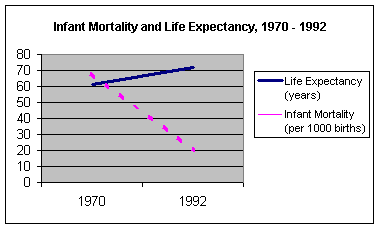
In IELTS, you will often get two or three graphs or tables, and you have to relate them to each other. Don’t just write one paragraph about each.The two charts below give information on the changes in life expectancy along with government spending on health and education in the United Arab Emirates.

the IELTS Academic Task 1 Writing is an information transfer task related to the factual content of an input text(s), graph(s), table(s) or diagram(s). It can be combinations of these inputs. Usually you will have to describe the information given in 1, 2 or 3 three inputs but sometimes you have will have to describe a process shown in a diagram.
Marking for the IELTS Academic Task 1 Writing
The IELTS Academic Task 1 Writing will be marked in four areas. You will get a mark from 1 to 9 on Task Achievement, Coherence & Cohesion, Lexical Resource and Grammatical Range and Accuracy. Your final band for task 1 will be effectively an average of the four marks awarded in these areas. Task 1 writing is less important than task 2 and to calculate the final writing mark, more weight is assigned to the task 2 mark than to task 1's mark. To get a good overall mark for The IELTS Academic Task 1 Writing though, both tasks have to be well answered so don't hold back on task 1 or give yourself too little time to answer it properly.Task Achievement This where you can really make a difference through careful preparation. This mark grades you on basically "have you answered the question". It marks whether you have covered all requirements of the task suffiently and whether you presented, highlighted and illustrate the key points appropriately.
Coherence and Cohesion These two are interrelated which is why they are done together. Cohesion is how your writing fits together. Does your writing with its ideas and content flow logically? Coherence is how you are making yourself understood and whether the reader of your writing understands what you are saying. An example of bad coherence and cohesion would be as follows:
1 We went to the beach because it was raining.
Probably the writer of this sentence does not mean "because" as people don't usually go to the beach when it is raining. The writer should have written:
2 We went to the beach although it was raining.
Sentence 1 has made a cohesion and coherence error (as well as a vocabulary one). "Because" does not join the ideas of the sentence together correctly and, as a result, the reader does not understand what the writer wants to say. This is an exaggerated example but it shows what I mean. Good cohesion and coherence is not noticeable as it allows the writing to be read easily. Good cohesion and coherence also includes good and appropriate paragraph usage.
Lexical Resource This area looks at the your choice of words. The marker will look at whether the right words are used and whether they are used at the right time in the right place and in the right way. To get a good mark here, the word choice should not only be accurate but wide ranging, natural and sophisticated.
Grammatical Range and Accuracy Here the examiner will mark your appropriate, flexible and accurate use of grammatical structures. Many people are worried about their grammar but, as you can see, grammar is only one section of four used to grade your writing. IELTS is much more interested in communication rather than grammatical accuracy. It is, of course, still part of the marking scheme and important as such.
Paragraphing for the IELTS Academic Task 1 Writing
This is a very easy thing to do but it can have an enormous effect on the intelligibility of your writing and, of course, good use of paragraphing is part of the marking under the section Coherence and Cohesion. Very often people use no paragraphing in The IELTS Academic Task 1 Writing and the examiner is faced with a "sea" of writing with no breaks from start to finish. Use paragraphs separated by an empty line and also indented. In this way your ideas are separated clearly. It shows and gives organization to your writing and makes it more readable. For the IELTS Academic Task 1 Writing, you should have a paragraph for your small introduction, a paragraph for each graph that you are describing and a paragraph for your ending. If there's only one graph to be described, then you should split your writing into 2 or maybe 3 paragraphs for the one graph. Make sure you practise on relevant questions from IELTS practice tests, so that you experienced at dealing with this issue.Numeric Scale on the Graph for the IELTS Academic Task 1 Writing
Scale means: whether the graphs are marked in hundreds, thousands, millions, pounds, dollars (US, Canadian, Australian, New Zealand, etc.), kilograms, tons, metres, kilometres, percent and so on. It's important for you to make clear what your numbers mean for an accurate report of the graph. Don't just say that something costs 1000 for instance. Say it costs 1000 US dollars. You can either specify the scales at the start in your introduction so the reader knows it for the whole report or you can use the scale each time you quote a detail in the report.Writing the Task for The IELTS Academic Task 1 Writing
The IntroductionYou don't need much here. You only have 150 words to fully answer the question and this is not much. So, you need 1 or 2 sentences describing the following:
- The type(s) of graph you are describing
- The titles of the graph(s)
- The date of the graph(s)
- The scale (see the paragraph above)
In this report I am going to describe 2 graphs. The first one is a bar chart showing the relationship between age and crime and the second is a pie chart showing the types of reported crime in the UK in 2002.
(This example gives an introduction to the Academic Writing Task 1 in Test 3 from ieltshelpnow.com.)
Describing Graphs for The IELTS Academic Task 1 Writing
What you need to do here is factually describe the graphs. You don't need to analyse the data, For example you don't need to give reasons for why figures are high or low. Sometimes, when there is more than 1 graph, there is a relationship between the two and you can bring in some comparison but more than this is not necessary. In the same way, no specialised knowledge of your own is needed or wanted nor your opinions.Remember the function of many graphs is to describe a trend so be sure that you describe the trends. A trend is how values change generally over time and it is important to describe the changes along with some of the individual values. We will look at trends a bit later under line graphs.
One important issue with The IELTS Academic Task 1 Writing is how much detail to include in your report. This depends really on how much detail there is in the question. If there is only 1 graph and it doesn't have much numerical data in it, then you will be expected to include all or nearly all of the numerical detail. If, however, you have 2 graphs, both of which are very complicated with lots of values, you will not be expected to include everything as you only have 150 words to do the job. What you will have to do is to include a selection of what you feel is the most important and significant detail that needs to be included to accurately describe the graph. With practice from good IELTS practice tests, you will improve at including all the necessary detail with the right amount of words.
You must always have some numerical detail though.
Now let's look individually at the types of graph that you are likely to meet in the exam and how to describe them.
Bar Charts for The IELTS Academic Task 1 Writing
You described the title of the bar chart in your introduction so you can go straight into the description. With a bar chart, you need to describe the bars and their values. When describing a bar chart you first have to decide in what order to describe the bars, highest value to lowest value or lowest value to highest value. It may be a mixture of this.If there are many bars, some of which have similar or the same values, you may group them together for description. If there are very many bars and you can't group them, then just describe the ones that are the most significant.Pie Charts for The IELTS Academic Task 1 Writing
Pie charts are relatively straightforward as they only usually have a few sections though this is not always the case. You need to describe the segments and their values. If there are very many then just describe the ones that are the most significant. The values are often expressed in percentages but not always so be careful what scale you are using.Tables for The IELTS Academic Task 1 Writing
These can sometimes be tricky as they provide a lot of information and it is often awkward and difficult to describe every piece of information. You have to decide and describe the values and sections that are the most significant.Line Graphs for The IELTS Academic Task 1 Writing
The function of a line graph is to describe a TREND pictorially. You therefore should try and describe the trend in it. If there are many lines in the graph(s), then just generally describe the trend. If there is only one or two, then use more detail. So, describe the movement of the line(s) of the graph giving numerical detail at the important points of the line.To describe the movement, there is some language which will always be useful. Below is a list of language you can use. Check with your dictionary words that you don't understand and practice using the words/phrases so you use them in the right way. As you will see, there are a number of words which are similar in meaning. This means that you will be able to use a variety of vocabulary which gives a good impression to the examiner who will read and mark your writing. The words below are particularly useful for line graphs but they can also be used where appropriate to describe the other types of graph.
Expressing the Movement of a Line
| Verbs | Nouns |
| Rise (to) | a rise |
| Increase (to) | an increase |
| Go up to | |
| Grow (to) | growth |
| Climb (to) | a climb |
| Boom | a boom |
| Peak (at) | (reach) a peak (at) |
| Fall (to) | a fall (of) |
| Decline (to) | a decline (of) |
| Decrease (to) | a decrease (of) |
| Dip (to) | a dip (of) |
| Drop (to) | a drop (of) |
| Go down (to) | |
| Reduce (to) | a reduction (of) |
| A slump | |
| Level out | a leveling out |
| No change | no change |
| Remain stable (at) | |
| Remain steady (at) | |
| Stay (at) | |
| Stay constant (at) | |
| Maintain the same level | |
| Adjectives | Adverbs |
| Dramatic | dramatically |
| Sharp | sharply |
| Huge | hugely |
| Enormous | enormously |
| Steep | steeply |
| Substantial | substantially |
| Considerable | considerably |
| Significant | significantly |
| Marked | markedly |
| Moderate | moderately |
| Slight | slightly |
| Small | |
| Minimal | minimally |
Describing the Speed of a Change |
|
| Adjectives | Adverbs |
| Rapid | rapidly |
| Quick | quickly |
| Swift | swiftly |
| Sudden | suddenly |
| Steady | steadily |
| Gradual | gradually |
| Slow | slowly |
The Ending for the IELTS Academic Task 1 Writing
You do not need a long and analytical conclusion for The IELTS Academic Task 1 Writing, but I do feel that you need to write something to end the report for reasons of structure. All you need to do is to write:This ends my report.
This is all you need to end your Task 1; I think it's important to do this as it rounds off the report for the reader.
Describing a Process for the IELTS Academic Task 1 Writing
You might have to describe a diagram representing a process.First of all, the introduction and the ending should be more or less the same.
Then, work out the various stages of the process. Take each one separately (it's only probably going to have a limited number of stages) and describe them fully. Fully is the important word as reaching the word limit has proved harder in this task. If you have this problem, don't be afraid to use your imagination to add to detail about the process.
Other Hints for the IELTS Academic Task 1 Writing
- DON'T copy any part of the question in your answer. This is not your own work and therefore will be disregarded by the examiner and deducted from the word count. You can use individual words but be careful of using long "chunks" of the question text.
- Don't repeat yourself or the same ideas.
- Iuse short sentences. This allows you to control the grammar and the meaning of your writing much more easily and contributes to a better cohesion and coherence mark. It's much easier to make things clear in a foreign language if you keep your sentences short!
- Think about the tenses of your verbs. If you're writing about something that happened in the past, your verbs will need to be in the past tenses. If you're describing the future, you will need to use the future tenses. If it's a habitual action, you'll need the present simple tense and so on. If you have time, a quick check of your verbs at the end of the exam can help you find errors. For describing graphs you will probably need past tenses whereas, for describing a process, you will probably need the present simple. Think about the verbs while practising and then it will become easier when you do the exam.
- As I just said, if you have finished the exam with time to spare, DON'T just sit there!! Check what you have done. If you have time after the check, check again. And so on....
- Don't be irrelevant. Although you can use your imagination to expand on your answer, if any part of your report is totally unrelated to the question and put in to just put up the word count, then the examiner will not take it into account and deduct it from the word count.
Academic Test Tutorials
The Academic Listening Test Tutorial The Academic Reading Test Tutorial The Academic Speaking Test Tutorial The Academic Writing Test - Task 1 Tutorial The Academic Writing Test - Task 2 TutorialThis link has dozens of model answers.
http://www.ielts-writing.info/index.php/academic-writing-task-1/
Journalists! Master Studiengang in Bonn (DW)
http://www.dw.de/dw-akademie/application/s-12278
Diplomats! Training for International Diplomats
http://www.auswaertiges-amt.de/EN/AusbildungKarriere/InternationDiplAusbildung/Uebersicht_node.html
U.N. Internships:
http://www.un.org/Depts/OHRM/sds/internsh/
EU Internships:
http://ec.europa.eu/stages/index_en.htm
http://europa.eu/about-eu/working-eu-institutions/traineeships/index_en.htm
http://fra.europa.eu/en/about-fra/recruitment/internship
http://www.euintheus.org/what-you-can-do/work-with-us-internships/
European Court of Human Rights
http://www.coe.int/en/web/jobs/traineeships
Praktika beim Auswärtigen Amt
http://www.auswaertiges-amt.de/DE/AusbildungKarriere/AA-Taetigkeit/Praktika/Praktika_node.html
http://www.dw.de/dw-akademie/application/s-12278
Diplomats! Training for International Diplomats
http://www.auswaertiges-amt.de/EN/AusbildungKarriere/InternationDiplAusbildung/Uebersicht_node.html
U.N. Internships:
http://www.un.org/Depts/OHRM/sds/internsh/
EU Internships:
http://ec.europa.eu/stages/index_en.htm
http://europa.eu/about-eu/working-eu-institutions/traineeships/index_en.htm
http://fra.europa.eu/en/about-fra/recruitment/internship
http://www.euintheus.org/what-you-can-do/work-with-us-internships/
European Court of Human Rights
http://www.coe.int/en/web/jobs/traineeships
Praktika beim Auswärtigen Amt
http://www.auswaertiges-amt.de/DE/AusbildungKarriere/AA-Taetigkeit/Praktika/Praktika_node.html
Criminal Law Vocabulary - Strafrecht
Accomplice; Accessory; Abettor – der Gehilfe;
Principal - Haupttäter
Complicity – die Beihilfe
Nötigung – Duress; coercion
Rape - Vergewaltigung
Robbery - Raub
Murder – Mord;
Manslaughter – Totschlag
Homicide – Tötung
Arson - Brandstiftung
Burglary - Einbruchdiebstahl
Theft -
Diebstahl
Suspect – der Verdächtiger
Gang – der (kriminelle) Band
Victim – der Opfer
First time offender / First offender
Recidivism – Rückfall
Untersuchungshaft – Preliminary Detention
Felony - Verbrechen
Misdemeanor - Vergehen
Violation - Ordnungswidrigkeit
Felon - Verbrecher
Felon - Verbrecher
Criminal - Verbrecher
Tax Evasion – Steuerhinterziehung
Tax Avoidance – Steuervermeidung
Offence against the person
Offence against property
Bust out – Betrugsanleihe mit anschliessenden Versicherungsbetrug
und Scheinbankrott
Counterfeiting – Geldfälschung, Fälschung
Fraud - Betrug
Treason – Verrat
High Treason - Höchstverrat
Espionage - Spionage
Bagatelldelikt – Minor offence; trifling offence
RICO
Adhäsionsverfahren – Tort claim arising out of criminal
complaint
Intentional – Vorsätzlich; Absichtlich
General Intent
Specific Intent
Assault - Bedrohung
Battery - Körperverletzung
Attempt – Versuch
Embezzlement - Unterschlagung
Extortion – Erpressung
Blackmail – Erpressung
Greenmail
Fencing – Hehlerei
Insider trading / Insider dealing – Insiderhandel
Market manipulation – Kursmanipulation
Bribery - Bestechung
Slander – Üble Nachrede
Defamation -
Libel - Verleumdung
Insult – Beschimpfung
Surveillance – Beobachtung
Protective Surveillance - Überwachung
Wire-tapping
Lauschangriff
False imprisonment
- Freiheitsberaubung
Abduction / Kidnapping - Entführung
Hostage Taking - Geiselnahme
Hijacking - Flugzeugentführung
Trespass – (Haus)friedensbruch
Forgery – Fälschung
Destruction of Evidence – Zerstörung Beweismittels
Criminal Combination – Krimineller Verein
(To Bear) False Witness – falsches Zeugnis
Money Laundering - Geldwäsche
Perjury – falsches Zeugnis
Element – Bestandteil
Element of the crime - Tatbestand
Impossibility - Unmöglichkeit
Self defence
Justification
Excuse
Defence; Verteidigung; Verteidigungsmittel
Criminal Capacity - Straffähigkeit
Mahnverfahren –
Mahnbrief – Warning Letter
Mahnung - Warning
Manhunt – Jagd auf jemand; Suche
Mayhem; Maiming -
Larceny- Entwendung
Accessory - Gehilfe
Fine - Bußgeld
Imprisonment - Freiheitsstrafe
Acquittal - Freispruch
Probation - Bewährung
Attenuating Circumstance; Mitigating Circumstance -
Strafmilderungsgrund
Aggravating - Strafschärfung
Mitigating Circumstance – mildernder Umstand;
Strafmilderungsgrund
Pardon – Begnadigung
Suspended Sentence
Time Served
Good behavior
Remand – Untersuchungshaft (U.K.), Zurückweisung dem unteren
Instantz (U.S.)
Bewährung
Strafvollzug – enforcement of sentence
Released on his own recognizance – Unter selbst Bewährung
Bail; Bail bond
Verjährung – Prescription; Statute of Limitations
Forgery – Fälschung
Hit-and-run - Fahrerflucht
Strike – Streik
Slow-down
Lock-out
Riot – Krawalle
Incitement - Anstiftung
Bankruptcy - Bankrott
Notwehr – Self defence
Notstand – Emergency situation, which justifies action;
necessity
Unfair competition – unlauterer Wettbewerb
Tortious interference with a contract -
Open Access Links
Open access legal scholarship links:
http://www.doaj.org/
http://vifa-recht.gbv.de
http://www.base-search.net
http://www.referat.com/catalog/?topic=%CF%F0%E0%E2%EE&start=45
Vocabulary
http://www.doaj.org/
http://vifa-recht.gbv.de
http://www.base-search.net
http://www.referat.com/catalog/?topic=%CF%F0%E0%E2%EE&start=45
Vocabulary
Define or find a synonym for each term:
Presumption______________________________________________
Rebuttable Presumption___________________________________
Irrebuttable Presumption_________________________________
Assumption_______________________________________________
Refutation_______________________________________________
Foundation_______________________________________________
Grounds__________________________________________________
Precondition_____________________________________________
Burden of proof__________________________________________
Shifting the burden of proof_____________________________
International law________________________________________
Administrative law_______________________________________
European commission______________________________________
European council_________________________________________
Court____________________________________________________
Jury_____________________________________________________
Juror____________________________________________________
Appeal___________________________________________________
Question of law__________________________________________
Question of fact_________________________________________
Custom___________________________________________________
Customary law____________________________________________
precedent________________________________________________
condition precedent______________________________________
convention_______________________________________________
deference________________________________________________
vote_____________________________________________________
veto_____________________________________________________
consideration____________________________________________
principle________________________________________________
specific performance_____________________________________
pure economic losses_____________________________________
damages__________________________________________________
injury___________________________________________________
injunction (temporary/permanent)_________________________
temporary restraining order______________________________
with respect to__________________________________________
tort_____________________________________________________
contract_________________________________________________
property_________________________________________________
appellant________________________________________________
appellee_________________________________________________
appellor_________________________________________________
res ipsa loquitor________________________________________
ultra vires______________________________________________
usufruct_________________________________________________
usus_____________________________________________________
abusus___________________________________________________
use value________________________________________________
exchange value___________________________________________
oppression_______________________________________________
repression_______________________________________________
oppression_______________________________________________
suppression______________________________________________
depression_______________________________________________
dialectic________________________________________________
liberation_______________________________________________
life tenancy_____________________________________________
life estate_______________________________________________
trust____________________________________________________
indict___________________________________________________
grand jury_______________________________________________
petit jury_______________________________________________
inquisitorial____________________________________________
accusatorial_____________________________________________
case law_________________________________________________
statutes_________________________________________________
laws_____________________________________________________
regulations______________________________________________
directives_______________________________________________
court of equity__________________________________________
court of law_____________________________________________
substantive law__________________________________________
procedural law___________________________________________
relevant_________________________________________________
treaty___________________________________________________
convention_______________________________________________
civil procedure__________________________________________
civil law________________________________________________
civil code_______________________________________________
ambiguous________________________________________________
interpretation___________________________________________
critique_________________________________________________
criticisim_______________________________________________
criticise________________________________________________
literal__________________________________________________
figurative_______________________________________________
metaphoric_______________________________________________
crime____________________________________________________
criminal law_____________________________________________
criminal_________________________________________________
arbitration______________________________________________
adversary________________________________________________
adversarial proceeding___________________________________
lex talionis_____________________________________________
institute________________________________________________
instigate________________________________________________
bring suit_______________________________________________
bring a lawsuit__________________________________________
to sue___________________________________________________
adjudication_____________________________________________
to judge_________________________________________________
comprehend_______________________________________________
understand_______________________________________________
percieve_________________________________________________
opinion__________________________________________________
decision_________________________________________________
decide___________________________________________________
verdict__________________________________________________
barrister________________________________________________
solicitor________________________________________________
contingent fee___________________________________________
punitive damages_________________________________________
real property____________________________________________
personal property________________________________________
intellectual property____________________________________
material property________________________________________
immaterial property______________________________________
liability________________________________________________
imputation_______________________________________________
reciprocity______________________________________________
opposite_________________________________________________
opposition_______________________________________________
object (v)_______________________________________________
object (n)_______________________________________________
objection________________________________________________
offer____________________________________________________
acceptance_______________________________________________
promise__________________________________________________
mutual___________________________________________________
expectation interest_____________________________________
expectancy_______________________________________________
counteroffer_____________________________________________
bargain__________________________________________________
negotation_______________________________________________
arguments________________________________________________
option___________________________________________________
stock option_____________________________________________
stock____________________________________________________
share____________________________________________________
option contract__________________________________________
similar__________________________________________________
same_____________________________________________________
analogy__________________________________________________
compel___________________________________________________
inculpate________________________________________________
exculpate________________________________________________
blameworthy______________________________________________
praiseworthy_____________________________________________
reform___________________________________________________
source___________________________________________________
resource_________________________________________________
sovereignty______________________________________________
rule of law______________________________________________
check____________________________________________________
cash_____________________________________________________
money order______________________________________________
acquit___________________________________________________
dissent__________________________________________________
majority_________________________________________________
majority opinion_________________________________________
dissent__________________________________________________
equivocal________________________________________________
ambiguous________________________________________________
contradiction____________________________________________
guilty___________________________________________________
innocent_________________________________________________
tort_____________________________________________________
presumed innocent________________________________________
innocent until proven guilty_____________________________
more likely than not_____________________________________
beyond doubt_____________________________________________
beyond reasonable doubt__________________________________
restitution______________________________________________
teleology________________________________________________
ontology_________________________________________________
indict___________________________________________________
prosecute________________________________________________
remand___________________________________________________
reverse__________________________________________________
cease____________________________________________________
desist___________________________________________________
proxy____________________________________________________
circumstances____________________________________________
principle________________________________________________
policy___________________________________________________
practice_________________________________________________
right____________________________________________________
claim____________________________________________________
compensation_____________________________________________
nominal damages__________________________________________
punitive damages_________________________________________
general damages__________________________________________
special damages__________________________________________
causation________________________________________________
German Legal Dictionaries
http://iate.europa.eu/iatediff/SearchByQueryLoad.do;jsessionid=9ea7991930d6b500ecd332a446118d27d31a7ef1cbf6.e38KbN4MchyMb40SbxyRaN0LbNj0?method=load
https://docs.google.com/spreadsheet/ccc?key=0AjLPEKGFyiCCdFdOQjYwT1cwRkszeG5UQXN2dE5zZEE&hl=en#gid=0
http://www.lexexakt.de/indexv.php?gebiet=en-law?buchstabe=a
http://www.degruyter.com/view/product/59088 paywall but Humboldt access.
http://wicourts.gov/services/interpreter/docs/germanglossary.pdf
http://www.online-recht.de/vorgl.html?intro
http://web.archive.org/web/20011018030944/http://www.heymanns.com/html/recht/ratgeber_recht/rechtslexikon/Lexikon.htm
http://web.archive.org/web/20020215203601/http://www.hamburg.de/StadtPol/Gerichte/VG/rechtslexikon.htm
https://docs.google.com/spreadsheet/ccc?key=0AjLPEKGFyiCCdFdOQjYwT1cwRkszeG5UQXN2dE5zZEE&hl=en#gid=0
http://www.lexexakt.de/indexv.php?gebiet=en-law?buchstabe=a
http://www.degruyter.com/view/product/59088 paywall but Humboldt access.
http://wicourts.gov/services/interpreter/docs/germanglossary.pdf
http://www.online-recht.de/vorgl.html?intro
http://web.archive.org/web/20011018030944/http://www.heymanns.com/html/recht/ratgeber_recht/rechtslexikon/Lexikon.htm
http://web.archive.org/web/20020215203601/http://www.hamburg.de/StadtPol/Gerichte/VG/rechtslexikon.htm
LII Toolbar
Ooh! Australian Legal Information Institute (Austlii) has updated their toolbar!
http://www.austlii.edu.au/techlib/toolbar/
Joy!
http://www.austlii.edu.au/techlib/toolbar/
Joy!
Videos on Basic Legal Method: Briefing cases, IRAC, Referencing
These videos are optional material you may find useful/fun.
Caveat: This site==> http://www.youtube.com/user/Lawschoolsuccess is not good. It's only a giant advertisement (Werbung). Ignore that site.
HOW TO BRIEF CASES
Rememeber, in case briefing we are looking for the facts, the rule.
http://www.youtube.com/watch?v=feucSsK_L50
This is good because he points out the link between briefing the case and the IRAC formula.
This is also about case briefing , it might be easier to follow since it is also in writing:
http://www.youtube.com/watch?v=lH1XkaFD2C0&NR=1
I sent this IRAC link in the mail earlier, I think it's good.
http://www.youtube.com/watch?v=g6KOsHYiL3k&NR=1
This isn't the IRAC link I sent earlier but is also good
http://www.youtube.com/watch?v=NtLV_0HRLB4
This one is good: NO CONCLUSORY REASONING show me the Reasons not just the Outcome!
http://www.youtube.com/watch?v=An-1xWBRLmM&NR=1
IRAC -- I dont think this is good but you might disagree.
http://www.youtube.com/watch?v=BfcUay1xx2U&feature=related
this site^ has 2 others on irac http://www.youtube.com/user/JonesCollegeJAX
http://www.youtube.com/watch?v=FvuiFoO3Ulc
Corporation - This one is definitely relevant for my corporation course.
http://www.youtube.com/watch?v=cY2EhEYbk1U&feature=related
Affidavit - YouTube - This one is generally relevant.
http://www.youtube.com/watch?v=fT4DrWTYQD0&NR=1
Reading Cases Guide - YouTube -- It's ok, but only that.
http://www.youtube.com/watch?v=LlvGCAkM3XQ&NR=1
Legal Writing Skills Module 3: WRITING AND REFERENCING - It's ok, but only that.
http://www.youtube.com/watch?v=KXHx5xcB6C4&NR=1
pols424: reading cases - It's ok, but only that.
http://www.youtube.com/user/LawStudySystems#p/u
Consideration (Contracts) - Not relevant to either of my courses but really well done.
I wrote these search engines while at Harvard
http://www.law.harvard.edu/students/orgs/hela/searchengines.html
The world legal information institute http://www.worldlii.org/
has links to free online law from a variety of jurisdictions.
As of yet there is no E.U. or German L.I.I.
I would like to build one.
Caveat: This site==> http://www.youtube.com/user/Lawschoolsuccess is not good. It's only a giant advertisement (Werbung). Ignore that site.
HOW TO BRIEF CASES
Rememeber, in case briefing we are looking for the facts, the rule.
http://www.youtube.com/watch?v=feucSsK_L50
This is good because he points out the link between briefing the case and the IRAC formula.
This is also about case briefing , it might be easier to follow since it is also in writing:
http://www.youtube.com/watch?v=lH1XkaFD2C0&NR=1
I sent this IRAC link in the mail earlier, I think it's good.
http://www.youtube.com/watch?v=g6KOsHYiL3k&NR=1
This isn't the IRAC link I sent earlier but is also good
http://www.youtube.com/watch?v=NtLV_0HRLB4
This one is good: NO CONCLUSORY REASONING show me the Reasons not just the Outcome!
http://www.youtube.com/watch?v=An-1xWBRLmM&NR=1
IRAC -- I dont think this is good but you might disagree.
http://www.youtube.com/watch?v=BfcUay1xx2U&feature=related
this site^ has 2 others on irac http://www.youtube.com/user/JonesCollegeJAX
http://www.youtube.com/watch?v=FvuiFoO3Ulc
Corporation - This one is definitely relevant for my corporation course.
http://www.youtube.com/watch?v=cY2EhEYbk1U&feature=related
Affidavit - YouTube - This one is generally relevant.
http://www.youtube.com/watch?v=fT4DrWTYQD0&NR=1
Reading Cases Guide - YouTube -- It's ok, but only that.
http://www.youtube.com/watch?v=LlvGCAkM3XQ&NR=1
Legal Writing Skills Module 3: WRITING AND REFERENCING - It's ok, but only that.
http://www.youtube.com/watch?v=KXHx5xcB6C4&NR=1
pols424: reading cases - It's ok, but only that.
http://www.youtube.com/user/LawStudySystems#p/u
Consideration (Contracts) - Not relevant to either of my courses but really well done.
I wrote these search engines while at Harvard
http://www.law.harvard.edu/students/orgs/hela/searchengines.html
The world legal information institute http://www.worldlii.org/
has links to free online law from a variety of jurisdictions.
As of yet there is no E.U. or German L.I.I.
I would like to build one.
Acronyms!
Abbreviations Links
http://www.abbreviations.com/acronyms/LAW
Law Abbreviations
http://www.legal-abbreviations.org/index/a.html
Legal Abbreviations that start with A
http://en.wikipedia.org/wiki/List_of_legal_abbreviations
List of legal abbreviations - Wikipedia, the free encyclopedia
http://members.cox.net/govdocs/govspeak.html
GovSpeak: A Guide to Government Acronyms & Abbreviations
http://lib.law.washington.edu/pubs/acron.html
Acronyms & Abbreviations
http://lib.law.washington.edu/cilp/abbrev.html
Bluebook Abbreviations of Law Reviews & Legal Periodicals Indexed in
CILP
Permalinks: These will Not go stale. They are identical to the links above.
http://web.archive.org/web/20110426060944/http://www.abbreviations.com
/acronyms/LAW
Law Abbreviations
http://web.archive.org/web/20100420060404/http://www.legal-abbreviatio
ns.org/?
LEGAL ABBREVIATIONS ONLINE at Legal-Abbreviations.org
http://web.archive.org/web/20100427025104/http://en.wikipedia.org/wiki
/List_of_legal_abbreviations
List of legal abbreviations - Wikipedia, the free encyclopedia
http://web.archive.org/web/20110721215331/http://members.cox.net/govdo
cs/govspeak.html
GovSpeak: A Guide to Government Acronyms & Abbreviations
http://web.archive.org/web/20101213234320/http://lib.law.washington.ed
u/pubs/acron.html
Acronyms & Abbreviations
http://web.archive.org/web/20110720112624/http://lib.law.washington.ed
u/cilp/abbrev.html
Bluebook Abbreviations of Law Reviews & Legal Periodicals Indexed in
CILP
http://www.abbreviations.com/acronyms/LAW
Law Abbreviations
http://www.legal-abbreviations.org/index/a.html
Legal Abbreviations that start with A
http://en.wikipedia.org/wiki/List_of_legal_abbreviations
List of legal abbreviations - Wikipedia, the free encyclopedia
http://members.cox.net/govdocs/govspeak.html
GovSpeak: A Guide to Government Acronyms & Abbreviations
http://lib.law.washington.edu/pubs/acron.html
Acronyms & Abbreviations
http://lib.law.washington.edu/cilp/abbrev.html
Bluebook Abbreviations of Law Reviews & Legal Periodicals Indexed in
CILP
Permalinks: These will Not go stale. They are identical to the links above.
http://web.archive.org/web/20110426060944/http://www.abbreviations.com
/acronyms/LAW
Law Abbreviations
http://web.archive.org/web/20100420060404/http://www.legal-abbreviatio
ns.org/?
LEGAL ABBREVIATIONS ONLINE at Legal-Abbreviations.org
http://web.archive.org/web/20100427025104/http://en.wikipedia.org/wiki
/List_of_legal_abbreviations
List of legal abbreviations - Wikipedia, the free encyclopedia
http://web.archive.org/web/20110721215331/http://members.cox.net/govdo
cs/govspeak.html
GovSpeak: A Guide to Government Acronyms & Abbreviations
http://web.archive.org/web/20101213234320/http://lib.law.washington.ed
u/pubs/acron.html
Acronyms & Abbreviations
http://web.archive.org/web/20110720112624/http://lib.law.washington.ed
u/cilp/abbrev.html
Bluebook Abbreviations of Law Reviews & Legal Periodicals Indexed in
CILP
Subscribe to:
Posts (Atom)