Academic IELTS Test Writing Task 1.
The task here is to describe a graph in a report. The report is intended for a university lecturer, so the language you use should be appropriate.
There are several different graphs you could see in a Writing Task 1:
Single line graph – see example
Double line graph – see example
Bar graph (Single, Double or Triple bar graph) – see example
Pie chart – see example
Table – see example
Process
No matter what graph, diagram or table you are describing, you shouldn’t break these rules:
Your report must be of at least 150 words written in 20 minutes.
You shouldn’t write your opinion or copy words from the task prompt – rephrase and use synonyms instead.
Never use bullets, write as if you were writing an essay or a letter.
When your Academic Writing Task 1 is graded by IELTS examiners, they look for this structure:
Introduction
Body
Conclusion
The Introduction should describe the purpose of your report and say what overall trends you see.
For example, if the graph is climbing up or dropping down, you should mention that.You need to remember that you are describing a graph to someone who doesn’t see it. Write what the graph is about, its dates and location.
The Body should describe the most important trends, while all information is summarized to avoid unnecessary details. For example, if there is a graph that has 2 peaks, you should mention them; tell when those peaks appeared and what the peak values are. Notice how many distinctive features the diagram has and divide information into paragraphs, one paragraph per feature. You should link the paragraphs by sentences that logically connect them to one another.
Important! You need to write about all the periods of time and all the subjects of graph. If it shows several years (1992, 1993, 1994) – write about all of them, if it is about men and women – write about both. Remember, summarizing doesn’t mean throwing away information. The secret here is to select what’s important, organize it, compare and contrast.
The Conclusion should sum up the global trends shown on the graph and compare them if possible.
And if you need some sample answers, here they are, enjoy.
http://www.ielts-blog.com/ielts-preparation-tips/writing-tips/ielts-academic-test-tips-for-writing-task-1/
EXAMPLES OF CHARTS
PIE CHART
Academic IELTS candidatesThis graph is similar to the recent ones that were given in IELTS exams, which is why it makes a good practice. Here is your homework for the day:
You should spend about 20 minutes on this task.
The following pie charts and the table show how three countries (USA, UK and Malaysia) deal with dangerous waste. Write a report for a university lecturer describing the information below.
You should write at least 150 words.

Amount of waste generated in three countries in year 2000:

mt = million tons


The first graph shows the foreign exchange earned by Egypt. The biggest sector is tourism, at 26% of the foreign exchange earnings. This is followed by industry, at 24%, and Workers remittances, which make up 21%. Incomes from the Suez Canal and from petroleum contribute a further quarter, and agriculture represents only 2%.
The second graph shows the amount of money Egypt earned from tourism between 1982 and 2003. in 1982, it only earned $0.3 billion, but this shot up over the next eleven years to $1.9 billion. it continued to rise until it reached a peak in 2000 of $4.3 billion, but then plunged suddenly, to a low of $1.8 billion in 2003, less than half the amount of the previous year.
In conclusion, although Egypt relied for a quarter of its income in 2002 on tourism, this amount varies sharply from year to year.
The three charts below give information on the gender breakdown, highest level obtained and location of students in the Higher Colleges of Technology in 1999. The Higher Colleges of Technology, or HCT, is a major government third-level institution in the United Arab Emirates. Write a report based on the information in the two graphs.


The two charts below give information on the changes in the types of fast food eaten in the UK between 1970 and 1990.


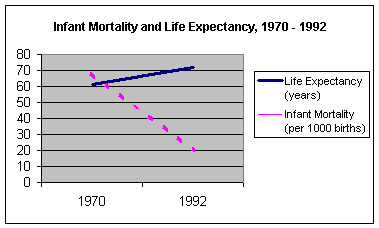
The two charts below give information on the changes in life expectancy along with government spending on health and education in the United Arab Emirates.


the IELTS Academic Task 1 Writing is an information transfer task related to the factual content of an input text(s), graph(s), table(s) or diagram(s). It can be combinations of these inputs. Usually you will have to describe the information given in 1, 2 or 3 three inputs but sometimes you have will have to describe a process shown in a diagram.
Task Achievement This where you can really make a difference through careful preparation. This mark grades you on basically "have you answered the question". It marks whether you have covered all requirements of the task suffiently and whether you presented, highlighted and illustrate the key points appropriately.
Coherence and Cohesion These two are interrelated which is why they are done together. Cohesion is how your writing fits together. Does your writing with its ideas and content flow logically? Coherence is how you are making yourself understood and whether the reader of your writing understands what you are saying. An example of bad coherence and cohesion would be as follows:
1 We went to the beach because it was raining.
Probably the writer of this sentence does not mean "because" as people don't usually go to the beach when it is raining. The writer should have written:
2 We went to the beach although it was raining.
Sentence 1 has made a cohesion and coherence error (as well as a vocabulary one). "Because" does not join the ideas of the sentence together correctly and, as a result, the reader does not understand what the writer wants to say. This is an exaggerated example but it shows what I mean. Good cohesion and coherence is not noticeable as it allows the writing to be read easily. Good cohesion and coherence also includes good and appropriate paragraph usage.
Lexical Resource This area looks at the your choice of words. The marker will look at whether the right words are used and whether they are used at the right time in the right place and in the right way. To get a good mark here, the word choice should not only be accurate but wide ranging, natural and sophisticated.
Grammatical Range and Accuracy Here the examiner will mark your appropriate, flexible and accurate use of grammatical structures. Many people are worried about their grammar but, as you can see, grammar is only one section of four used to grade your writing. IELTS is much more interested in communication rather than grammatical accuracy. It is, of course, still part of the marking scheme and important as such.
You don't need much here. You only have 150 words to fully answer the question and this is not much. So, you need 1 or 2 sentences describing the following:
In this report I am going to describe 2 graphs. The first one is a bar chart showing the relationship between age and crime and the second is a pie chart showing the types of reported crime in the UK in 2002.
(This example gives an introduction to the Academic Writing Task 1 in Test 3 from ieltshelpnow.com.)
Remember the function of many graphs is to describe a trend so be sure that you describe the trends. A trend is how values change generally over time and it is important to describe the changes along with some of the individual values. We will look at trends a bit later under line graphs.
One important issue with The IELTS Academic Task 1 Writing is how much detail to include in your report. This depends really on how much detail there is in the question. If there is only 1 graph and it doesn't have much numerical data in it, then you will be expected to include all or nearly all of the numerical detail. If, however, you have 2 graphs, both of which are very complicated with lots of values, you will not be expected to include everything as you only have 150 words to do the job. What you will have to do is to include a selection of what you feel is the most important and significant detail that needs to be included to accurately describe the graph. With practice from good IELTS practice tests, you will improve at including all the necessary detail with the right amount of words.
You must always have some numerical detail though.
Now let's look individually at the types of graph that you are likely to meet in the exam and how to describe them.
To describe the movement, there is some language which will always be useful. Below is a list of language you can use. Check with your dictionary words that you don't understand and practice using the words/phrases so you use them in the right way. As you will see, there are a number of words which are similar in meaning. This means that you will be able to use a variety of vocabulary which gives a good impression to the examiner who will read and mark your writing. The words below are particularly useful for line graphs but they can also be used where appropriate to describe the other types of graph.
This ends my report.
This is all you need to end your Task 1; I think it's important to do this as it rounds off the report for the reader.
First of all, the introduction and the ending should be more or less the same.
Then, work out the various stages of the process. Take each one separately (it's only probably going to have a limited number of stages) and describe them fully. Fully is the important word as reaching the word limit has proved harder in this task. If you have this problem, don't be afraid to use your imagination to add to detail about the process.
 The Academic Listening Test Tutorial
The Academic Reading Test Tutorial
The Academic Speaking Test Tutorial
The Academic Writing Test - Task 1 Tutorial
The Academic Writing Test - Task 2 Tutorial
This link has dozens of model answers.
http://www.ielts-writing.info/index.php/academic-writing-task-1/
The task here is to describe a graph in a report. The report is intended for a university lecturer, so the language you use should be appropriate.
There are several different graphs you could see in a Writing Task 1:
Introduction
Body
Conclusion
The Introduction should describe the purpose of your report and say what overall trends you see.
For example, if the graph is climbing up or dropping down, you should mention that.You need to remember that you are describing a graph to someone who doesn’t see it. Write what the graph is about, its dates and location.
The Body should describe the most important trends, while all information is summarized to avoid unnecessary details. For example, if there is a graph that has 2 peaks, you should mention them; tell when those peaks appeared and what the peak values are. Notice how many distinctive features the diagram has and divide information into paragraphs, one paragraph per feature. You should link the paragraphs by sentences that logically connect them to one another.
Important! You need to write about all the periods of time and all the subjects of graph. If it shows several years (1992, 1993, 1994) – write about all of them, if it is about men and women – write about both. Remember, summarizing doesn’t mean throwing away information. The secret here is to select what’s important, organize it, compare and contrast.
The Conclusion should sum up the global trends shown on the graph and compare them if possible.
And if you need some sample answers, here they are, enjoy.
http://www.ielts-blog.com/ielts-preparation-tips/writing-tips/ielts-academic-test-tips-for-writing-task-1/
EXAMPLES OF CHARTS
PIE CHART
Academic IELTS candidatesThis graph is similar to the recent ones that were given in IELTS exams, which is why it makes a good practice. Here is your homework for the day:
You should spend about 20 minutes on this task.
The following pie charts and the table show how three countries (USA, UK and Malaysia) deal with dangerous waste. Write a report for a university lecturer describing the information below.
You should write at least 150 words.
Amount of waste generated in three countries in year 2000:
mt = million tons
BAR CHART Graphs: Tourism in Egypt
The two charts below show the importance of Tourism to Egypt’s economy. Write a report based on the information in the two graphs.

Sample IELTS Answer: Egypt’s Tourism Industry
The graphs show how important tourism is for Egypt. Overall, even though tourism is the biggest sector in the economy, the income fluctuates sharply from year to year.The first graph shows the foreign exchange earned by Egypt. The biggest sector is tourism, at 26% of the foreign exchange earnings. This is followed by industry, at 24%, and Workers remittances, which make up 21%. Incomes from the Suez Canal and from petroleum contribute a further quarter, and agriculture represents only 2%.
The second graph shows the amount of money Egypt earned from tourism between 1982 and 2003. in 1982, it only earned $0.3 billion, but this shot up over the next eleven years to $1.9 billion. it continued to rise until it reached a peak in 2000 of $4.3 billion, but then plunged suddenly, to a low of $1.8 billion in 2003, less than half the amount of the previous year.
In conclusion, although Egypt relied for a quarter of its income in 2002 on tourism, this amount varies sharply from year to year.
Sample Graphs: Higher Colleges
In IELTS, you will often get two or three graphs or tables, and you have to relate them to each other. Don’t just write one paragraph about each.The three charts below give information on the gender breakdown, highest level obtained and location of students in the Higher Colleges of Technology in 1999. The Higher Colleges of Technology, or HCT, is a major government third-level institution in the United Arab Emirates. Write a report based on the information in the two graphs.


The two charts below give information on the changes in the types of fast food eaten in the UK between 1970 and 1990.


Graphs: Multiple Graphs: UAE Health Statistics
In IELTS, you will often get two or three graphs or tables, and you have to relate them to each other. Don’t just write one paragraph about each.The two charts below give information on the changes in life expectancy along with government spending on health and education in the United Arab Emirates.

the IELTS Academic Task 1 Writing is an information transfer task related to the factual content of an input text(s), graph(s), table(s) or diagram(s). It can be combinations of these inputs. Usually you will have to describe the information given in 1, 2 or 3 three inputs but sometimes you have will have to describe a process shown in a diagram.
Marking for the IELTS Academic Task 1 Writing
The IELTS Academic Task 1 Writing will be marked in four areas. You will get a mark from 1 to 9 on Task Achievement, Coherence & Cohesion, Lexical Resource and Grammatical Range and Accuracy. Your final band for task 1 will be effectively an average of the four marks awarded in these areas. Task 1 writing is less important than task 2 and to calculate the final writing mark, more weight is assigned to the task 2 mark than to task 1's mark. To get a good overall mark for The IELTS Academic Task 1 Writing though, both tasks have to be well answered so don't hold back on task 1 or give yourself too little time to answer it properly.Task Achievement This where you can really make a difference through careful preparation. This mark grades you on basically "have you answered the question". It marks whether you have covered all requirements of the task suffiently and whether you presented, highlighted and illustrate the key points appropriately.
Coherence and Cohesion These two are interrelated which is why they are done together. Cohesion is how your writing fits together. Does your writing with its ideas and content flow logically? Coherence is how you are making yourself understood and whether the reader of your writing understands what you are saying. An example of bad coherence and cohesion would be as follows:
1 We went to the beach because it was raining.
Probably the writer of this sentence does not mean "because" as people don't usually go to the beach when it is raining. The writer should have written:
2 We went to the beach although it was raining.
Sentence 1 has made a cohesion and coherence error (as well as a vocabulary one). "Because" does not join the ideas of the sentence together correctly and, as a result, the reader does not understand what the writer wants to say. This is an exaggerated example but it shows what I mean. Good cohesion and coherence is not noticeable as it allows the writing to be read easily. Good cohesion and coherence also includes good and appropriate paragraph usage.
Lexical Resource This area looks at the your choice of words. The marker will look at whether the right words are used and whether they are used at the right time in the right place and in the right way. To get a good mark here, the word choice should not only be accurate but wide ranging, natural and sophisticated.
Grammatical Range and Accuracy Here the examiner will mark your appropriate, flexible and accurate use of grammatical structures. Many people are worried about their grammar but, as you can see, grammar is only one section of four used to grade your writing. IELTS is much more interested in communication rather than grammatical accuracy. It is, of course, still part of the marking scheme and important as such.
Paragraphing for the IELTS Academic Task 1 Writing
This is a very easy thing to do but it can have an enormous effect on the intelligibility of your writing and, of course, good use of paragraphing is part of the marking under the section Coherence and Cohesion. Very often people use no paragraphing in The IELTS Academic Task 1 Writing and the examiner is faced with a "sea" of writing with no breaks from start to finish. Use paragraphs separated by an empty line and also indented. In this way your ideas are separated clearly. It shows and gives organization to your writing and makes it more readable. For the IELTS Academic Task 1 Writing, you should have a paragraph for your small introduction, a paragraph for each graph that you are describing and a paragraph for your ending. If there's only one graph to be described, then you should split your writing into 2 or maybe 3 paragraphs for the one graph. Make sure you practise on relevant questions from IELTS practice tests, so that you experienced at dealing with this issue.Numeric Scale on the Graph for the IELTS Academic Task 1 Writing
Scale means: whether the graphs are marked in hundreds, thousands, millions, pounds, dollars (US, Canadian, Australian, New Zealand, etc.), kilograms, tons, metres, kilometres, percent and so on. It's important for you to make clear what your numbers mean for an accurate report of the graph. Don't just say that something costs 1000 for instance. Say it costs 1000 US dollars. You can either specify the scales at the start in your introduction so the reader knows it for the whole report or you can use the scale each time you quote a detail in the report.Writing the Task for The IELTS Academic Task 1 Writing
The IntroductionYou don't need much here. You only have 150 words to fully answer the question and this is not much. So, you need 1 or 2 sentences describing the following:
- The type(s) of graph you are describing
- The titles of the graph(s)
- The date of the graph(s)
- The scale (see the paragraph above)
In this report I am going to describe 2 graphs. The first one is a bar chart showing the relationship between age and crime and the second is a pie chart showing the types of reported crime in the UK in 2002.
(This example gives an introduction to the Academic Writing Task 1 in Test 3 from ieltshelpnow.com.)
Describing Graphs for The IELTS Academic Task 1 Writing
What you need to do here is factually describe the graphs. You don't need to analyse the data, For example you don't need to give reasons for why figures are high or low. Sometimes, when there is more than 1 graph, there is a relationship between the two and you can bring in some comparison but more than this is not necessary. In the same way, no specialised knowledge of your own is needed or wanted nor your opinions.Remember the function of many graphs is to describe a trend so be sure that you describe the trends. A trend is how values change generally over time and it is important to describe the changes along with some of the individual values. We will look at trends a bit later under line graphs.
One important issue with The IELTS Academic Task 1 Writing is how much detail to include in your report. This depends really on how much detail there is in the question. If there is only 1 graph and it doesn't have much numerical data in it, then you will be expected to include all or nearly all of the numerical detail. If, however, you have 2 graphs, both of which are very complicated with lots of values, you will not be expected to include everything as you only have 150 words to do the job. What you will have to do is to include a selection of what you feel is the most important and significant detail that needs to be included to accurately describe the graph. With practice from good IELTS practice tests, you will improve at including all the necessary detail with the right amount of words.
You must always have some numerical detail though.
Now let's look individually at the types of graph that you are likely to meet in the exam and how to describe them.
Bar Charts for The IELTS Academic Task 1 Writing
You described the title of the bar chart in your introduction so you can go straight into the description. With a bar chart, you need to describe the bars and their values. When describing a bar chart you first have to decide in what order to describe the bars, highest value to lowest value or lowest value to highest value. It may be a mixture of this.If there are many bars, some of which have similar or the same values, you may group them together for description. If there are very many bars and you can't group them, then just describe the ones that are the most significant.Pie Charts for The IELTS Academic Task 1 Writing
Pie charts are relatively straightforward as they only usually have a few sections though this is not always the case. You need to describe the segments and their values. If there are very many then just describe the ones that are the most significant. The values are often expressed in percentages but not always so be careful what scale you are using.Tables for The IELTS Academic Task 1 Writing
These can sometimes be tricky as they provide a lot of information and it is often awkward and difficult to describe every piece of information. You have to decide and describe the values and sections that are the most significant.Line Graphs for The IELTS Academic Task 1 Writing
The function of a line graph is to describe a TREND pictorially. You therefore should try and describe the trend in it. If there are many lines in the graph(s), then just generally describe the trend. If there is only one or two, then use more detail. So, describe the movement of the line(s) of the graph giving numerical detail at the important points of the line.To describe the movement, there is some language which will always be useful. Below is a list of language you can use. Check with your dictionary words that you don't understand and practice using the words/phrases so you use them in the right way. As you will see, there are a number of words which are similar in meaning. This means that you will be able to use a variety of vocabulary which gives a good impression to the examiner who will read and mark your writing. The words below are particularly useful for line graphs but they can also be used where appropriate to describe the other types of graph.
Expressing the Movement of a Line
| Verbs | Nouns |
| Rise (to) | a rise |
| Increase (to) | an increase |
| Go up to | |
| Grow (to) | growth |
| Climb (to) | a climb |
| Boom | a boom |
| Peak (at) | (reach) a peak (at) |
| Fall (to) | a fall (of) |
| Decline (to) | a decline (of) |
| Decrease (to) | a decrease (of) |
| Dip (to) | a dip (of) |
| Drop (to) | a drop (of) |
| Go down (to) | |
| Reduce (to) | a reduction (of) |
| A slump | |
| Level out | a leveling out |
| No change | no change |
| Remain stable (at) | |
| Remain steady (at) | |
| Stay (at) | |
| Stay constant (at) | |
| Maintain the same level | |
| Adjectives | Adverbs |
| Dramatic | dramatically |
| Sharp | sharply |
| Huge | hugely |
| Enormous | enormously |
| Steep | steeply |
| Substantial | substantially |
| Considerable | considerably |
| Significant | significantly |
| Marked | markedly |
| Moderate | moderately |
| Slight | slightly |
| Small | |
| Minimal | minimally |
Describing the Speed of a Change |
|
| Adjectives | Adverbs |
| Rapid | rapidly |
| Quick | quickly |
| Swift | swiftly |
| Sudden | suddenly |
| Steady | steadily |
| Gradual | gradually |
| Slow | slowly |
The Ending for the IELTS Academic Task 1 Writing
You do not need a long and analytical conclusion for The IELTS Academic Task 1 Writing, but I do feel that you need to write something to end the report for reasons of structure. All you need to do is to write:This ends my report.
This is all you need to end your Task 1; I think it's important to do this as it rounds off the report for the reader.
Describing a Process for the IELTS Academic Task 1 Writing
You might have to describe a diagram representing a process.First of all, the introduction and the ending should be more or less the same.
Then, work out the various stages of the process. Take each one separately (it's only probably going to have a limited number of stages) and describe them fully. Fully is the important word as reaching the word limit has proved harder in this task. If you have this problem, don't be afraid to use your imagination to add to detail about the process.
Other Hints for the IELTS Academic Task 1 Writing
- DON'T copy any part of the question in your answer. This is not your own work and therefore will be disregarded by the examiner and deducted from the word count. You can use individual words but be careful of using long "chunks" of the question text.
- Don't repeat yourself or the same ideas.
- Iuse short sentences. This allows you to control the grammar and the meaning of your writing much more easily and contributes to a better cohesion and coherence mark. It's much easier to make things clear in a foreign language if you keep your sentences short!
- Think about the tenses of your verbs. If you're writing about something that happened in the past, your verbs will need to be in the past tenses. If you're describing the future, you will need to use the future tenses. If it's a habitual action, you'll need the present simple tense and so on. If you have time, a quick check of your verbs at the end of the exam can help you find errors. For describing graphs you will probably need past tenses whereas, for describing a process, you will probably need the present simple. Think about the verbs while practising and then it will become easier when you do the exam.
- As I just said, if you have finished the exam with time to spare, DON'T just sit there!! Check what you have done. If you have time after the check, check again. And so on....
- Don't be irrelevant. Although you can use your imagination to expand on your answer, if any part of your report is totally unrelated to the question and put in to just put up the word count, then the examiner will not take it into account and deduct it from the word count.
Academic Test Tutorials
The Academic Listening Test Tutorial The Academic Reading Test Tutorial The Academic Speaking Test Tutorial The Academic Writing Test - Task 1 Tutorial The Academic Writing Test - Task 2 TutorialThis link has dozens of model answers.
http://www.ielts-writing.info/index.php/academic-writing-task-1/
